Are You in the Hot Seat to Implement GRC?
Peg Bailey • October 2, 2020
This is a subtitle for your new post
Losing a multi-million dollar opportunity is painful, but it will help your company’s stakeholders understand the necessity of compliance.
Now that you know that you are subject to regulation, how are you going to start? If you are a mid-sized company, you may not have the resources for a fully-staffed compliance department - but you still have to meet several hundred requirements.
Before you buy a Governance Risk and Compliance (GRC) solution, it’s important to put your processes in place. Which framework will you choose? NIST-CSF? SOC2? Then which controls are you going to start with? Password policy, encryption, or something else? Will it be practical to take productive time away from your subject matter experts to answer hundreds of questions over and over again?
It’s important to get the right kind of help with GRC implementation - someone who knows how to engineer processes and workflows and then automate them. Plenty of consultants would be happy to sell you a GRC solution, but they would be missing a huge step - putting your processes in place first.
SHAW Data Security has worked with companies who are at square one in implementing GRC. We will help you figure out the best processes that fit your company with the least amount of pain and then custom fit the GRC implementation to your resources and regulatory requirements.
SHAW Data Security is a US-based ServiceNow Premier partner, one of only 10 partners in the world with the GRC Product Line Achievement. We help customers modernize, optimize, and automate digital workflows.
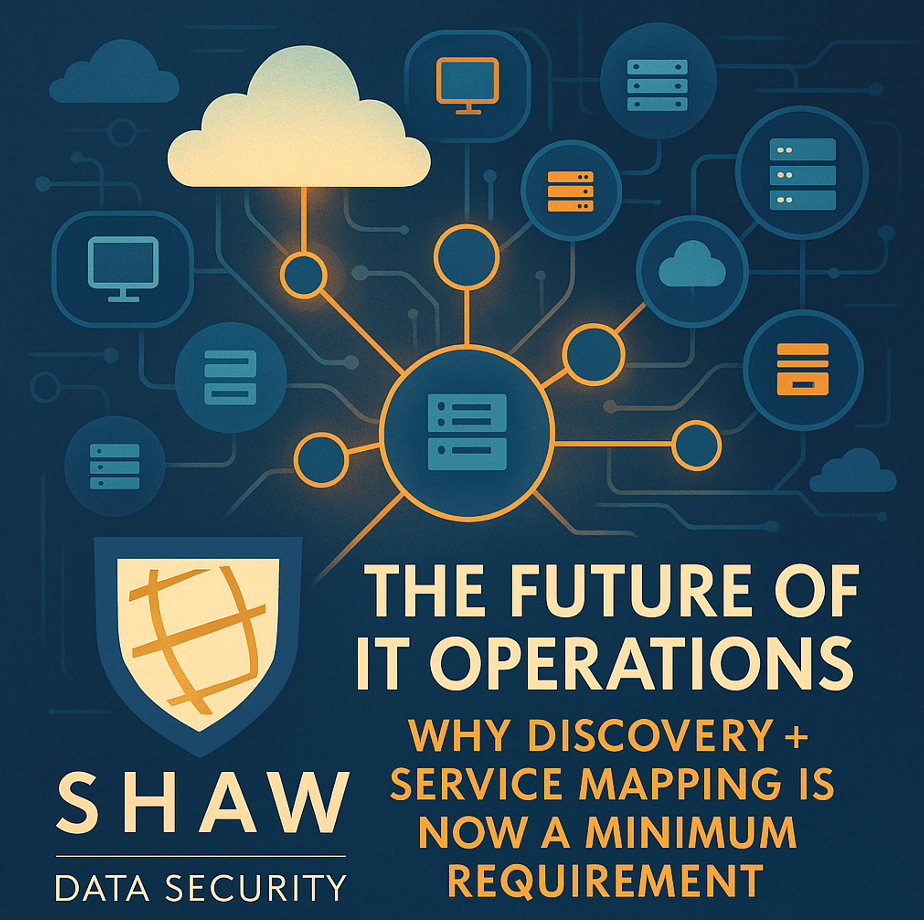
IT operations have changed more in the past five years than in the previous twenty. Cloud workloads, SaaS adoption, remote users, containerization, and identity-driven access have redefined how organizations manage their environments. Yet many companies still rely on outdated approaches to visibility. They track assets in spreadsheets. They manually update dependency diagrams. They troubleshoot outages without understanding what broke upstream or downstream. In today’s world, that is no longer sustainable. Discovery and Service Mapping are not advanced or optional. They are foundational requirements for any organization expecting stability, reliability, and operational maturity from ServiceNow. Why Visibility Is the New “Control Surface” of IT Modern IT environments are too dynamic for manual processes. Systems scale up and down. Integrations appear and disappear. Network routes shift. Cloud resources are born and die in seconds. Without automated visibility, IT teams are always operating from behind—responding instead of anticipating. Visibility is now the control surface of IT operations. You cannot govern, secure, or optimize what you cannot see. Discovery: The Automated Inventory Every Organization Needs ServiceNow Discovery scans the environment and identifies servers, devices, cloud resources, applications, and configurations. It updates the CMDB automatically, eliminating the need for human-driven inventory processes. Discovery ensures that organizations always know what they have, where it is located, who owns it, and how it is configured. Without Discovery, the CMDB becomes stale the moment the project ends. Manual data entry cannot keep up with modern infrastructure. Service Mapping: Understanding How Everything Connects Service Mapping builds the relationship layer that defines how infrastructure supports business services. It identifies dependencies, upstream and downstream components, and the technical paths that support critical operations. Service Mapping is essential for change management, incident response, risk analysis, and impact assessments. Organizations without Service Mapping simply cannot understand the true impact of an outage, a misconfiguration, or a major incident. Why These Capabilities Are Becoming Non-Negotiable Regulators, auditors, cybersecurity frameworks, and insurers are increasingly expecting automated, real-time visibility into environments. Manual processes no longer satisfy risk requirements. Business leaders expect accurate reporting, not assumptions. And customers expect uptime and reliability. Discovery and Service Mapping are no longer “nice to have.” They are foundational to meeting business expectations. Reducing Outages Through Accurate Impact Analysis The most common cause of an avoidable outage is a change made without true understanding of its impact. Without accurate dependency mapping, change approvals rely on intuition instead of data. With Service Mapping, change managers review actual relationships. They approve changes with confidence, understand risk, and prevent failures. Change success rates increase immediately. Accelerating Incident Response and Root Cause Analysis Incident responders waste valuable minutes trying to identify what broke, where it broke, and what depends on it. With Discovery and Service Mapping, responders see the entire chain instantly. They isolate root cause faster, restore services sooner, and reduce the overall cost of downtime. For critical infrastructure and regulated industries, this capability is invaluable. Preparing for AIOps, Automation, and Predictive Insights Organizations often want to adopt AIOps or automated remediation, but these tools require clean, accurate, relationship-rich data. Discovery and Service Mapping build the foundation needed for intelligent automation. AIOps cannot predict what it cannot understand. Automated workflows cannot self-heal what they cannot see. How SHAW Data Security Delivers Sustainable Visibility SHAW deploys Discovery and Service Mapping with emphasis on scalability, accuracy, and long-term governance. We ensure sensors, patterns, credentials, and data flows align with your environment. We build a clean class model, normalize attributes, and verify relationships. We train your teams to maintain visibility as environments evolve. Most importantly, our approach integrates Discovery and Service Mapping into ITSM, ITOM, IRM, and Security workflows so that visibility becomes an everyday operational advantage. The future of IT operations demands real-time visibility, reliable dependency mapping, and automation-ready data. Discovery and Service Mapping are the minimum requirements for operational maturity. Organizations that adopt these capabilities early gain stability, predictability, and significant reductions in downtime and risk.
Every organization wants its ServiceNow implementation to be predictable, well-run, and free of surprises. Yet the biggest challenge customers face is not technology. It is project management. Good project management determines whether the platform launches on time, whether users adopt it, whether stakeholders stay aligned, and whether the customer walks away with confidence or frustration. At SHAW Data Security, we have seen both ends of the spectrum. The difference between a struggling project and a successful one almost always comes down to structure, communication, ownership, and rhythm. Why ServiceNow Projects Fail Without Strong Project Management ServiceNow touches multiple teams, processes, and systems. Without clear structure, stakeholders lose visibility. Tasks pile up. Risks go unaddressed. Decisions stall. And when communication breaks down, the customer feels uncertainty—and uncertainty becomes dissatisfaction. A project without a disciplined project manager is like a platform without a CMDB: everything technically works, but nothing works well. The Core Principles of Effective ServiceNow Project Management Good project management starts before kick-off. It establishes the playbook, defines the expectations, and sets the tone for the entire engagement. The best-managed projects share the same characteristics: consistent communication, predictable reporting, clear decision ownership, and a focus on outcomes rather than tasks. Strong PMs make sure the customer never wonders what is happening, what is coming next, or what is at risk. Communication Rhythm: The Heartbeat of the Project The quality of communication determines the quality of the relationship. Good project management relies on structured, consistent communication rhythms. Weekly status calls, weekly written updates, sprint reviews, and clear points of contact form the backbone of trust. Customers care about one thing above all: predictability. When communication is predictable, the project feels stable and controlled—even when challenges arise. Reporting That Builds Confidence Instead of Confusion Customers expect accurate, timely project reporting. They want to know what was completed, what is planned, what decisions are needed, and where risks exist. Bad reporting creates anxiety. Clear reporting builds confidence. Good project management turns reporting into a leadership tool. It connects tasks to outcomes and ensures the customer always understands the true state of the project. Ownership and Escalation: Who Tells the Story? Who Owns the Emotion? Every successful implementation has clear ownership lines. Someone owns the timeline, someone owns the customer’s emotional experience, and someone owns the technical updates. When these roles are unclear, customers feel the gap immediately. A good project manager does not wait for concerns to surface—they escalate early, clearly, and constructively. Proactive escalation prevents surprises, protects relationships, and maintains progress. Risk Management as a Daily Discipline ServiceNow implementations change quickly. Scope expands, integrations require nuance, data reveals surprises, and dependencies shift. Effective PMs treat risk management as a continuous practice, not a checkpoint. They document risks early, discuss them openly, and recommend corrective actions. Strong PMs never let a risk become a crisis. Meeting Management: Start on Time, End on Time, Follow the Agenda Simple discipline separates average PMs from exceptional PMs. Meetings start on time, end on time, and follow an agenda. Decisions are documented. Action items have owners and due dates. Recaps are sent quickly. These habits create clarity and momentum. Customers interpret meeting discipline as an indicator of overall project discipline. They are almost always right. Why Process Is Not Bureaucracy—It Is Predictability Some teams mistake process for unnecessary structure. But good project management process reduces noise, accelerates work, and ensures every team member has the information they need. It creates transparency and lowers stress. In ServiceNow projects, process is the difference between progress and confusion. Process does not slow the project down. It removes friction so the project can move faster. How SHAW Data Security Delivers High-Quality Project Management SHAW’s project management model aligns communication, reporting, governance, and execution into a predictable experience. We use a consistent weekly reporting structure, clear ownership lines, and transparent escalation paths. We reinforce discipline in meetings, documentation, and risk tracking. Most importantly, we focus on the customer’s emotional experience. Projects succeed not only because the technology is delivered, but because the customer feels informed, supported, and confident at every stage. Great ServiceNow implementations are not driven by luck or technical excellence alone. They succeed because project management is structured, disciplined, predictable, and clear. Good project management earns trust, reduces risk, prevents surprises, and sets the foundation for a strong long-term partnership.
Organizations spend massive amounts of time gathering screenshots, exporting logs, tracking approvals, and manually assembling spreadsheets during audits. These hours are often invisible to leadership, yet they consume some of the most expensive resources in the company. What many organizations don’t realize is that ServiceNow Integrated Risk Management already includes a capability that eliminates most of this manual work: automated evidence collection. At SHAW Data Security, we see this overlooked feature deliver immediate value for every organization implementing IRM. When configured correctly, automated evidence transforms audit preparation from a scramble into a predictable, repeatable, low-effort process. Why Manual Evidence Collection Fails Traditional evidence gathering relies on human effort, inconsistent documentation, and decentralized storage. Each control owner prepares evidence their own way, often at the last minute. This results in mismatched formatting, incomplete submissions, and long cycles of back-and-forth with auditors. The process introduces risk, delays audits, and increases the operational burden on IT, Security, and Compliance teams. Manual processes are also impossible to scale. As organizations expand their control environment, add frameworks, or support multiple audits each year, the effort grows exponentially. How Automated Evidence Collection Works Automated evidence collection embeds evidence requirements directly into the workflow. ServiceNow triggers evidence collection at defined intervals or in response to specific events, then stores the results in a centralized repository tied directly to the control. Instead of hunting for documents, auditors and control owners access a single system with standardized formats. Automation ensures completeness, accuracy, and consistency. It reduces repetitive work and shifts accountability from individuals to the system, increasing reliability. Why Organizations Overlook This Feature Many organizations approach IRM with a compliance-first mindset and do not fully explore automation options. They replicate old spreadsheet-driven processes in a new platform, losing the benefits that automation is designed to deliver. Others avoid automation because they lack clean data or do not have a standardized control set. In nearly every engagement, the real barrier is not technology—it is process maturity and awareness. Where Automated Evidence Collection Delivers the Biggest ROI Automated evidence benefits every part of the audit lifecycle. Controls that require regular monitoring become self-maintaining. User access reviews become faster. System logs and configuration baselines update automatically. Approvals and change records link directly to controls without manual intervention. Organizations typically see a reduction of 30 to 50 percent in audit preparation time during the first cycle. As more controls adopt automation, time savings continue to grow. Enabling Cross-Framework Compliance Automated evidence supports NIST, SOX, HIPAA, PCI, and virtually any other framework mapped into ServiceNow. Once evidence is collected for one framework, it can be reused across others without rework. This dramatically reduces the burden on IT teams and increases consistency across compliance domains. Multi-framework alignment becomes easier because ServiceNow centralizes control inheritance and evidence mapping. Automation ensures that evidence fulfills requirements across multiple audits simultaneously. Improving Audit Confidence and Reducing Findings Evidence collected manually is prone to error and inconsistency. Automated evidence is reliable, timestamped, system-generated, and immune to human oversight. This improves audit confidence and reduces findings based on incomplete or outdated evidence. Auditors gain visibility into real-time evidence instead of relying on point-in-time documents. Control owners gain assurance that compliance is maintained continuously, not just during audit season. How SHAW Data Security Enables Automated Evidence Our IRM implementations prioritize evidence automation early. We establish a control library, normalize attributes, and align evidence with operational workflows. We configure event-driven and scheduled evidence collection to ensure long-term sustainability. We also train your teams to maintain evidence jobs and adjust them as frameworks evolve. SHAW’s focus on automation allows customers to scale compliance without increasing headcount, reduce audit stress, and accelerate time-to-value for IRM. Automated evidence collection is one of the most powerful capabilities within ServiceNow IRM, yet it is often overlooked or underused. Organizations that activate evidence automation experience dramatic reductions in manual effort, stronger audit outcomes, and greater operational efficiency. It is the key step that transforms compliance from a burden into a streamlined, predictable process.
Most organizations shop for IT Service Management because they want faster ticket resolution, better user experiences, fewer outages, and stronger operational consistency. These are good goals, but they cannot be achieved with ITSM alone. The engine behind every successful ServiceNow implementation is a well-designed, well-maintained CMDB strategy. Without it, even the most expensive ITSM investment underperforms. At SHAW Data Security, we see a consistent pattern across mid-market and enterprise clients. The organizations that establish a CMDB strategy early experience smoother deployments, cleaner data, better reporting, and significantly higher adoption. Those that skip this step often struggle with reliability, integrations, and long-term scalability. The CMDB Is the Foundation of ServiceNow A CMDB is more than a database. It is the backbone that connects infrastructure, applications, assets, changes, incidents, knowledge, and workflows into a living operational picture. When your CMDB is healthy, every module becomes more effective. When it is incomplete or inaccurate, everything becomes reactive. The CMDB dictates how data flows, how automation behaves, and how decisions are made. If the foundation is weak, the outcomes will suffer regardless of how strong the ITSM processes are. Why Buying ITSM Without a CMDB Creates Operational Gaps Organizations often underestimate how dependent ITSM is on contextual data. Incident routing depends on ownership. Change planning depends on dependency mapping. Major incident escalation depends on knowing what is critical and what is not. A CMDB without strategy leads to manual work, slow resolution, and inconsistent reporting. Without a CMDB strategy, your service desk becomes less automated. Changes become more risky. Visibility becomes fragmented. Everything becomes harder because the platform cannot see the environment it is meant to support. What a CMDB Strategy Should Include A CMDB strategy defines the rules, guardrails, and operational standards needed to keep data accurate and usable. It sets expectations for what to discover, what to store, who owns each class of data, and how each part of the organization interacts with the model. A well-defined CMDB strategy includes naming conventions, class models, data governance, population sources, integration standards, and lifecycle management. It defines how often data should be reconciled, which attributes matter, and how to prevent bloat. Without this strategy, CMDB accuracy degrades immediately after go-live. Discovery, Integrations, and Data Governance Discovery tools such as ServiceNow Discovery and Service Graph Connectors must be aligned with governance and platform architecture. Automated discovery accelerates data population, but governance ensures the data remains trustworthy. Integrations must be mapped, normalized, and reconciled according to the CMDB structure. Governance ensures that data remains consistent, avoiding duplicates, gaps, or inaccurate relationships. Together, these components create a predictable, reliable CMDB capable of supporting enterprise automation and analytics. Why ITSM Outcomes Improve With a Mature CMDB A strong CMDB improves operational performance in measurable ways. Incident response becomes faster because routing is accurate. Change success rates increase because impact analysis is real, not guessed. Major incident management becomes proactive instead of reactive. Service mapping connects technical dependencies to business impact, improving prioritization. Every part of ITSM becomes easier to operate and govern. Organizations consistently report fewer outages and shorter resolution times once their CMDB reaches maturity. The Cost and Risk of Not Prioritizing the CMDB Without a CMDB strategy, technical debt grows. Teams spend more time troubleshooting avoidable issues. Dependency decisions become unclear. Reporting becomes inconsistent. Projects take longer because data work must be done retroactively. This reactive approach increases cost, extends timelines, and reduces the long-term value of the ServiceNow platform. Investing in ITSM without a CMDB is like building a house without a foundation. You can get the walls up, but it will not withstand long-term use. How SHAW Data Security Builds CMDB Success SHAW’s CMDB methodology focuses on simplicity, accuracy, and maintainability. We begin with a clear class model, normalized naming conventions, and automated discovery aligned to real business needs. We design a governance model that ensures your CMDB remains healthy months and years after go-live. Our approach accelerates adoption, reduces rework, and strengthens every downstream process including ITSM, ITOM, IRM, and Asset Management. Most importantly, we deliver a CMDB that is usable on day one and scalable for long-term operational maturity. Before organizations purchase ITSM or begin an implementation, they need a CMDB strategy. It ensures the platform is stable, reduces operational risk, increases reliability, and enables the automation ServiceNow is designed to deliver. A strong CMDB creates a strong ServiceNow environment, and the earlier the strategy is defined, the faster the platform produces real value.
Organizations rarely realize how much money they lose each year through fragmented tools, outdated systems, and manual processes. Legacy ITSM, IRM, and homegrown solutions might appear inexpensive on paper, but once you factor in the real operational costs, the ROI swings dramatically in favor of consolidation and modernization. At SHAW Data Security, we see this pattern in nearly every client engagement. The savings are measurable, repeatable, and significant. The True Cost of Staying on Legacy Systems Most teams underestimate the hidden burden of maintaining disconnected tools. Support platforms that cannot track dependencies lead to more extended outages. Assets stored in spreadsheets result in inaccurate inventories and unexpected technology spend. Compliance programs run in SharePoint or Excel create inconsistent evidence, duplicate work, and longer audits. Each inefficiency adds friction, cost, and risk. Beyond the technical debt, legacy tools create people-driven inefficiencies. Teams rely on tribal knowledge, manual tasks, and ad-hoc workarounds that slow delivery and increase errors. Leadership loses visibility because data lives in multiple systems that do not connect. These issues spread silently throughout the organization. Where ServiceNow Changes the Equation ServiceNow consolidates IT Service Management, Operations, Risk, and Asset data into one platform. When implemented correctly using a structured, predictable approach, the organization shifts from reactive to proactive operations. The long-term gains include lower ticket volume, faster change cycles, fewer outages, reduced compliance effort, centralized reporting, and a single source of truth. For many organizations, the financial value begins showing within months. Incident patterns become visible. Asset accuracy improves. Risk and audit workflows are standardized. Leaders gain dashboard-level insights that previously required days of manual reporting—even modest improvements in each area compound to create ROI. Eliminating Redundant Tools One of the biggest drivers of ROI is removing overlapping subscriptions. Many organizations maintain separate products for ticketing, asset management, change tracking, vendor assessments, and risk compliance. ServiceNow replaces these with platform-native modules that leverage shared data. This simplification reduces vendor spend, reduces integration maintenance, and eliminates the overhead of managing unrelated systems. Customers commonly retire three to five tools within the first year. The cost savings typically cover a substantial portion of the ServiceNow investment. Reducing Audit and Compliance Costs Compliance work is a significant hidden expense, especially in SOX, HIPAA, and NIST-driven environments. In legacy tools, audit readiness requires manual evidence gathering, point-in-time screenshots, inconsistent approvals, and rework. With ServiceNow IRM, evidence collection becomes automated, standardized, and repeatable. Controls align with workflows instead of creating extra work. Analysts spend less time preparing for audits and more time improving them. Organizations routinely see a 30 to 50 percent reduction in manual compliance effort once IRM is fully implemented. Lowering Operational Risk and Downtime Legacy systems lack dependency tracking, so teams often do not understand the upstream or downstream impacts of changes. This directly contributes to outages, failed deployments, and firefighting. ServiceNow Discovery and CMDB improve change accuracy, reduce failure rates, and shorten resolution times. Even a minor reduction in downtime can produce substantial financial benefit, especially for organizations with critical business systems. Improved Employee Experience and Retention The hidden ROI is not always financial. Modern service portals, automated workflows, and self-service features reduce end-user frustration and eliminate repetitive work for IT staff. Higher employee satisfaction leads to greater adoption, better service outcomes, and reduced turnover. Why SHAW Data Security Delivers ROI So Quickly SHAW’s implementations focus on foundational architecture, clean data, predictable delivery, and transparent reporting. We eliminate unnecessary complexity and ensure that every module is directly tied to business value. Whether deploying ITSM Professional, IRM, ITOM Visibility, or TPRM, the goal is always the same: measurable outcomes that increase efficiency and reduce cost. Our approach helps organizations realize value faster, avoid common pitfalls, and build long-term platform success. The real ROI of moving from legacy tools to ServiceNow goes far beyond licensing or project costs. It is the transformation of operations, the reduction of risk, the consolidation of technology, the acceleration of audits, and the enhancement of the employee experience. Organizations that make the shift gain a more predictable, efficient, and resilient future.
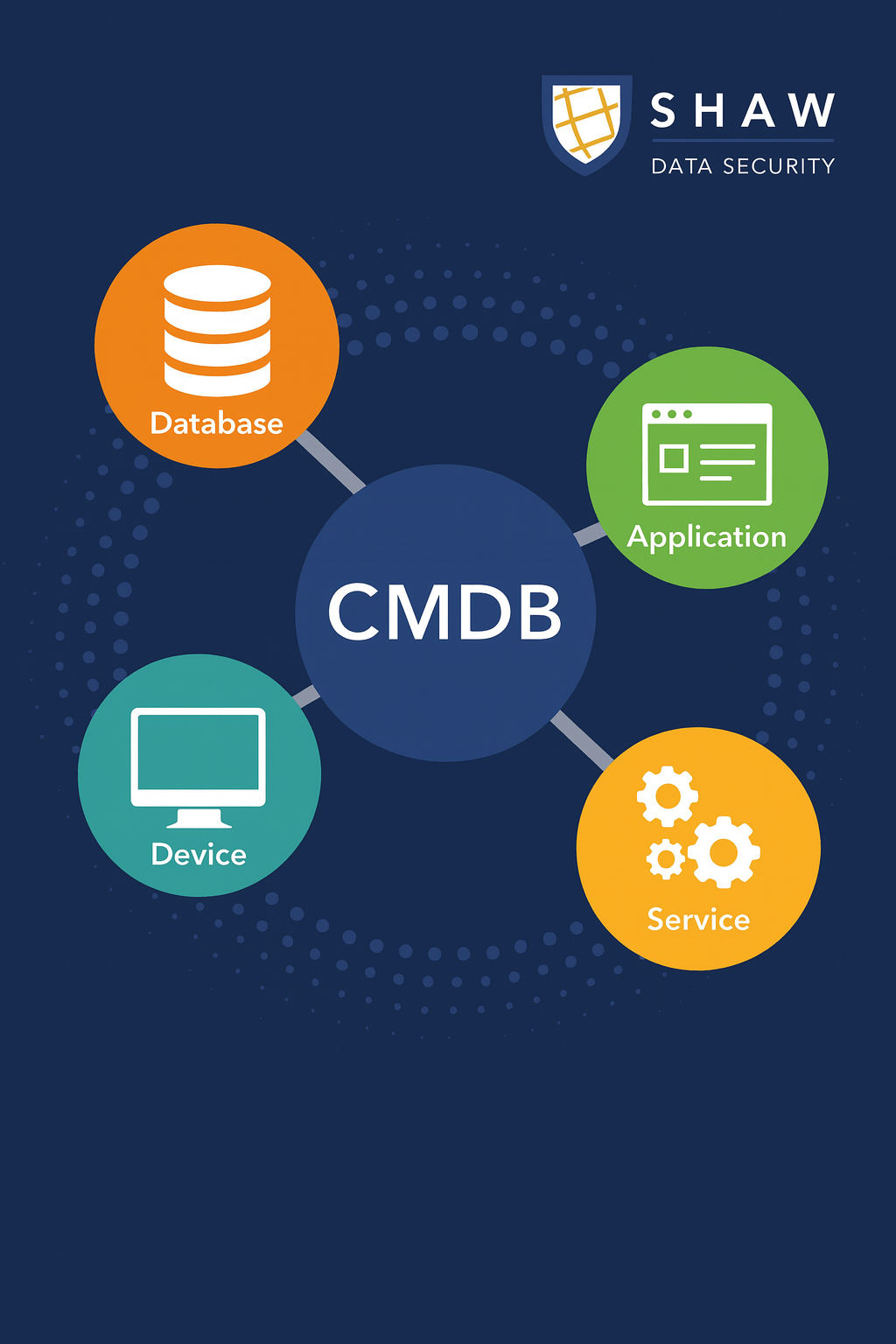
Organizations today depend on an expanding landscape of applications, cloud services, endpoints, and integrations. As environments grow in scale and complexity, one foundational capability has become essential to operational success. That capability is a well governed Configuration Management Database . At SHAW Data Security, we see the CMDB as the single most important driver of maturity across ITSM, ITOM, SecOps, IRM, and SPM. It allows teams to understand what they have, how it works, and how issues in one area create impacts across the enterprise. Why the CMDB Matters The CMDB provides a single source of truth for all configuration items. This accuracy is critical because teams cannot manage what they cannot see. A complete and trusted CMDB gives organizations clarity into their assets, relationships, and dependencies. It reduces blind spots, allows predictable decision making, and dramatically lowers operational risk. When the CMDB is healthy, every downstream process benefits. When the CMDB is unhealthy, every downstream process struggles. Operational Efficiency A modern CMDB drives faster triage, better incident routing, and more effective change analysis. Service desk teams resolve issues more quickly because they understand what systems are affected. Change managers can make informed decisions because they see upstream and downstream risk . Asset managers reduce waste because they know what is deployed, what is unused, and what needs lifecycle planning. Teams spend less time searching for information and more time delivering value. Security and Risk Reduction Security teams rely heavily on the CMDB. Without accurate configuration and relationship data, vulnerability management becomes reactive and inefficient. A mature CMDB allows faster prioritization of vulnerabilities, better scoping of incidents, and stronger alignment with frameworks like NIST and ISO. The CMDB also strengthens IT risk programs by connecting controls, processes, and assets. All risk and compliance activities improve when the underlying inventory is consistent and current. Enabling Automation and AI AI cannot operate effectively without clean data. The CMDB provides that foundation. Discovery, service mapping, and automation rules all depend on accurate records. A clean CMDB allows organizations to move from manual work to automated operations . It ensures that AI recommendations are meaningful and tied to real system data. As organizations adopt Now Assist and other AI capabilities, a healthy CMDB becomes even more important. Driving Strategic Decision Making Leadership relies on visibility. A strong CMDB provides insights that support budgeting, roadmapping, and resource allocation. When leaders understand how technology is used and how it supports business services, they can make better decisions. This is especially important in hybrid environments where cost, performance, and risk must be balanced constantly. Why Organizations Struggle Most organizations do not fail due to lack of tools. They struggle due to lack of governance, ownership, and operational discipline. Common issues include incomplete discovery, inconsistent naming conventions, unmanaged attributes, and weak lifecycle processes. Over time, these gaps compound and the CMDB becomes noisy and unreliable. Once trust is lost, teams stop using the data and maturity stalls. How SHAW Data Security Helps SHAW delivers a practical approach that balances accuracy with operational sustainability. We focus on visible results and realistic maintenance models. Our CMDB services include: • QuickStart CMDB setup tailored to your environment • Discovery and best practice configuration • CMDB health remediation • Governance models that define ownership and accountability • CI class rationalization and structured naming standards • Automated reconciliation and audit processes • Integration design to keep data consistent • Dashboards that measure health, coverage, and adoption We make the CMDB actionable by aligning it to Incident, Change, Problem, ITOM, SecOps, IRM, and SPM. The result is a living operational asset instead of a static repository. The CMDB is the foundation that supports every modern digital workflow. When built and governed correctly, it improves efficiency, security, and decision making. It reduces risk and accelerates transformation. Organizations with a healthy CMDB outperform organizations without one. SHAW Data Security partners with clients to build and maintain CMDB solutions that are accurate, trusted, and aligned with business needs. For teams looking to modernize operations, the CMDB is the starting point.

As Thanksgiving arrives, we pause to reflect on what this season represents for us at SHAW Data Security. Our company was founded in Concord, Massachusetts, a town known for quiet strength, historic resolve, and a commitment to doing what is right even when it is difficult. Those values continue to shape how we serve our clients across the country. Thanksgiving is a moment for gratitude, but it is also a time to recognize the importance of preparedness and resilience. New Englanders understand these lessons well. In Concord, traditions are built on shared responsibility. Families plan for long winters, communities support one another, and people take pride in building systems that endure. That same mindset guides our work in cybersecurity and ServiceNow transformations. Strong security is built the same way that strong communities are built. It requires forethought, structure, and consistent stewardship. At SHAW, we are grateful for the trust our clients place in us. This year brought significant changes across compliance frameworks, cybersecurity needs, and operational demands for organizations of every size. Our team has partnered with clients to strengthen IRM programs, enhance SecOps maturity, streamline ITSM operations, and modernize risk and compliance processes. These projects are not just technical exercises. They help organizations protect their people, deliver better services, and stay prepared for whatever comes next. Thanksgiving is also a chance to acknowledge how SHAW’s roots influence the work we do. Concord’s history reminds us that every meaningful change begins with leadership and clarity of purpose. The “Shot Heard Around the World” is not just the origin of our name. It represents the courage to take action when the moment calls for it. Our clients choose SHAW because they want a partner who understands when to advise, when to strategize, and when to act decisively. As families gather across New England and beyond, we remain thankful for the opportunity to help businesses build resilience in a landscape that keeps evolving. Our clients continue to inspire us. Their goals become our goals. Their challenges fuel our innovation. Their trust strengthens our resolve. In the coming year, SHAW will continue to stand by the principles that started in Concord and now define our work. We will keep delivering thoughtful ServiceNow implementations, strengthening cybersecurity programs, and supporting organizations with the same reliability and sense of purpose that New Englanders have relied on for generations. From our SHAW family to yours, we wish you a warm and meaningful Thanksgiving. May it be a time of reflection, community, and renewed strength for the year ahead.
For small and mid-sized businesses, technology has become both the backbone and the bottleneck. Every system, application, and endpoint is critical. But when those systems are invisible, unmanaged, or siloed, risk grows quietly. The truth is simple: you cannot protect, optimize, or manage what you cannot see. That is where ServiceNow IT Operations Management (ITOM) comes in — giving SMBs the visibility and control once reserved for large enterprises. The Modern SMB IT Challenge SMBs are more connected than ever before. They operate across hybrid clouds, SaaS platforms, and remote endpoints. Every tool adds capability, but also complexity. Over time, this creates three major pain points: Limited Visibility – IT leaders cannot see all assets, dependencies, or service health in one place. Reactive Operations – Issues are discovered after users report them. Inefficient Spend – Assets are underused, overbought, or mismanaged. These challenges cost SMBs real money — not in missed opportunities, but in downtime, inefficiency, and unnecessary renewal spend. How ServiceNow ITOM Solves It ServiceNow ITOM changes the way small and mid-sized organizations run their IT operations. It gives leaders complete visibility across the entire IT landscape, automatically mapping how systems, applications, and services connect. Here is how ITOM helps SMBs take control: Discovery and Visibility Automatically detect every asset, virtual machine, and cloud instance. Build an accurate CMDB (Configuration Management Database) without the manual effort. Service Mapping Visualize relationships between infrastructure and the business services they support. Understand which systems matter most to uptime and productivity. Event Management Replace hundreds of alerts with a single, intelligent view. Prioritize incidents based on real business impact. Operational Health Monitor performance, track trends, and identify issues before users even notice. Automation and Orchestration Eliminate repetitive maintenance and recovery tasks through prebuilt workflows, reducing human error and downtime. With ITOM, SMBs can finally move from reactive firefighting to proactive control . Where HAM Fits In Hardware Asset Management (HAM) is the other half of the visibility story. ITOM tells you what is running in your environment. HAM tells you what you own, where it is, and how it’s being used. For small and mid-sized businesses, HAM connects directly with ITOM to deliver: Accurate Asset Inventory – Automatic reconciliation between discovered devices and owned hardware. Lifecycle Management – Track assets from procurement through retirement. License Optimization – Identify unused or duplicate devices to reduce waste. Financial Clarity – Understand the total cost and utilization of your IT assets. Together, ITOM and HAM create a closed loop of visibility and control . ITOM discovers and monitors; HAM manages and governs. The result is a single, unified system that keeps IT efficient, compliant, and cost-effective. The Business Impact for SMBs When SMBs connect ITOM and HAM, the benefits extend far beyond the IT department: Fewer Outages – Issues are detected and resolved before they cause downtime. Reduced Costs – Eliminate redundant assets and improve license utilization. Improved Security – Discover untracked or shadow IT before it becomes a vulnerability. Data-Driven Decisions – Gain real metrics on asset performance, value, and lifecycle. Faster Growth – Free up IT resources to focus on innovation instead of maintenance. For leaders, this means better visibility. For IT, it means better efficiency. For the business, it means better results. SHAW’s Approach: Visibility, Velocity, and Value At SHAW Data Security , we specialize in helping SMBs deploy ServiceNow ITOM and HAM through fast, structured QuickStart implementations . Our focus is simple: deliver measurable results quickly, without enterprise overhead. Our clients typically see: Complete CMDB population in weeks, not months. 30% improvement in asset utilization. 40% faster incident resolution through integrated monitoring and automation. We design every implementation to grow with your business — starting with what matters most and expanding as your environment matures. It Matters Now Technology ecosystems are expanding faster than ever, and so are the risks. Without real-time visibility, even small disruptions can snowball into business outages or compliance failures. ServiceNow ITOM and HAM give SMBs the foundation to stay resilient. They provide the visibility, intelligence, and automation needed to keep systems healthy and secure — and the insight to make smarter business decisions. Because in today’s world, resilience starts with visibility. About SHAW Data Security SHAW Data Security helps organizations implement and optimize ServiceNow across ITSM, ITOM, IRM, SecOps, and CSM. Our QuickStart packages are designed for the mid-market, bringing enterprise-grade capability, speed, and measurable results.
For years, risk and compliance programs were built for the enterprise. They required massive teams, expensive tools, and layers of process that few small or mid-sized businesses (SMBs) could afford. But the risk landscape has changed. Cyber threats, vendor dependencies, and regulatory expectations now affect companies of every size. Today, SMBs need the same level of visibility and control as large enterprises — without the cost and complexity. That’s where ServiceNow Integrated Risk Management (IRM) makes a difference. The New Reality for SMBs Most SMBs operate in highly dynamic environments. They move fast, adapt quickly, and often rely on lean teams wearing multiple hats. That agility is an advantage, but it also exposes risk. Without an integrated system to track policies, risks, and controls, it’s easy for things to slip through the cracks — and a single missed control can create real consequences. For example: A vendor fails to meet cybersecurity standards, exposing sensitive data. A regulatory requirement is overlooked, triggering penalties. A policy is updated but never rolled out, leaving operations out of alignment. These issues often stem from one root cause: fragmented risk management. ServiceNow IRM changes that by creating a single, connected framework where every risk, control, and piece of evidence lives together. What ServiceNow IRM Delivers for SMBs ServiceNow IRM isn’t just a compliance tracker. It’s a living system that evolves with your organization. Here’s how it helps SMBs strengthen their governance and risk posture: Centralized Risk Visibility Gain a clear view of every operational, cyber, and vendor risk in one place. Each risk can be tied directly to a business objective, showing leaders what truly matters. Continuous Control Monitoring Automate evidence collection and control testing on a schedule that fits your organization. No more chasing spreadsheets or manual updates. Framework Alignment Manage compliance with standards like ISO 27001, SOC 2, NIST CSF, and HIPAA through prebuilt templates and cross-mapped controls. Real-Time Dashboards See audit readiness at a glance. Reports that once took days to compile are now available instantly. Integrated Workflows When a risk changes, controls, tasks, and owners update automatically. Accountability stays clear across departments. With IRM, risk management stops being a manual chore and becomes a proactive process — one that builds confidence across the entire organization. Why ServiceNow IRM Works for SMBs Large organizations use IRM to handle hundreds of frameworks and thousands of risks. SMBs need the same capability, just scaled to their size. ServiceNow’s modular architecture makes that possible. You can start small — focusing on vendor risk, cybersecurity, or compliance — and expand over time as your program matures. At SHAW Data Security , we design our IRM QuickStart program specifically for SMBs. Our approach delivers the essential capabilities of ServiceNow IRM in a matter of weeks, not months, with clear results: A functioning risk register Defined policy and control management workflows Configured dashboards for visibility and reporting Audit-ready evidence management You get a foundation for enterprise-grade risk management without enterprise complexity. al Results, Real Simplicity Organizations that deploy ServiceNow IRM with SHAW report measurable improvements in their first 90 days: Reduced audit preparation time by more than 50% Clear ownership for every control and task Fewer compliance gaps and manual follow-ups Improved executive insight into operational risk The difference is structure. Once your data, policies, and responsibilities live inside a unified system, governance stops being a burden and becomes a business advantage. hThis Matters Now In the modern market, trust is everything. Clients, regulators, and partners all want assurance that you are in control of your data, your vendors, and your obligations. ServiceNow IRM gives SMBs that assurance. It helps leaders prove — with real evidence — that their organization is managing risk effectively and continuously. The companies that adopt integrated risk management today will move faster, respond smarter, and build stronger reputations tomorrow. he SHAW Data Security Advantage SHAW Data Security helps SMBs modernize governance and compliance using the ServiceNow platform . Our QuickStart methodology emphasizes rapid delivery, transparency, and enablement. That means you get results quickly and your team has the skills to sustain them long-term. We believe risk management should empower growth, not slow it down. With SHAW and ServiceNow IRM, your organization can build a framework that’s simple, scalable, and built for confidence.

There are many consultants who would be happy to sell you GRC, but are inexperienced in the implementation of it. They will charge you more to factor in the unknown to “figure it out” as they go. A partner who is qualified with a ServiceNow GRC Product Line Achievement will guarantee competency, efficiency, and experience. Don’t hire someone who “dabbles,” work with someone who does this for a living. At SHAW Data Security, GRC and SecOps implementations are our specialty, and we know the best ways to integrate ITSM, CMDB and ITOM into the process as well. We advise and guide our customers through an efficient GRC implementation, customizing to their specific needs in the most efficient way. SHAW Data Security is a Boston-based ServiceNow Premier partner, one of only 10 partners in the world with the GRC Product Line Achievement. We help customers modernize, optimize, and automate digital workflows.