Why Every Organization Needs a CMDB Strategy Before They Buy ITSM
Most organizations shop for IT Service Management because they want faster ticket resolution, better user experiences, fewer outages, and stronger operational consistency. These are good goals, but they cannot be achieved with ITSM alone. The engine behind every successful ServiceNow implementation is a well-designed, well-maintained CMDB strategy. Without it, even the most expensive ITSM investment underperforms.
At SHAW Data Security, we see a consistent pattern across mid-market and enterprise clients. The organizations that establish a CMDB strategy early experience smoother deployments, cleaner data, better reporting, and significantly higher adoption. Those that skip this step often struggle with reliability, integrations, and long-term scalability.
The CMDB Is the Foundation of ServiceNow
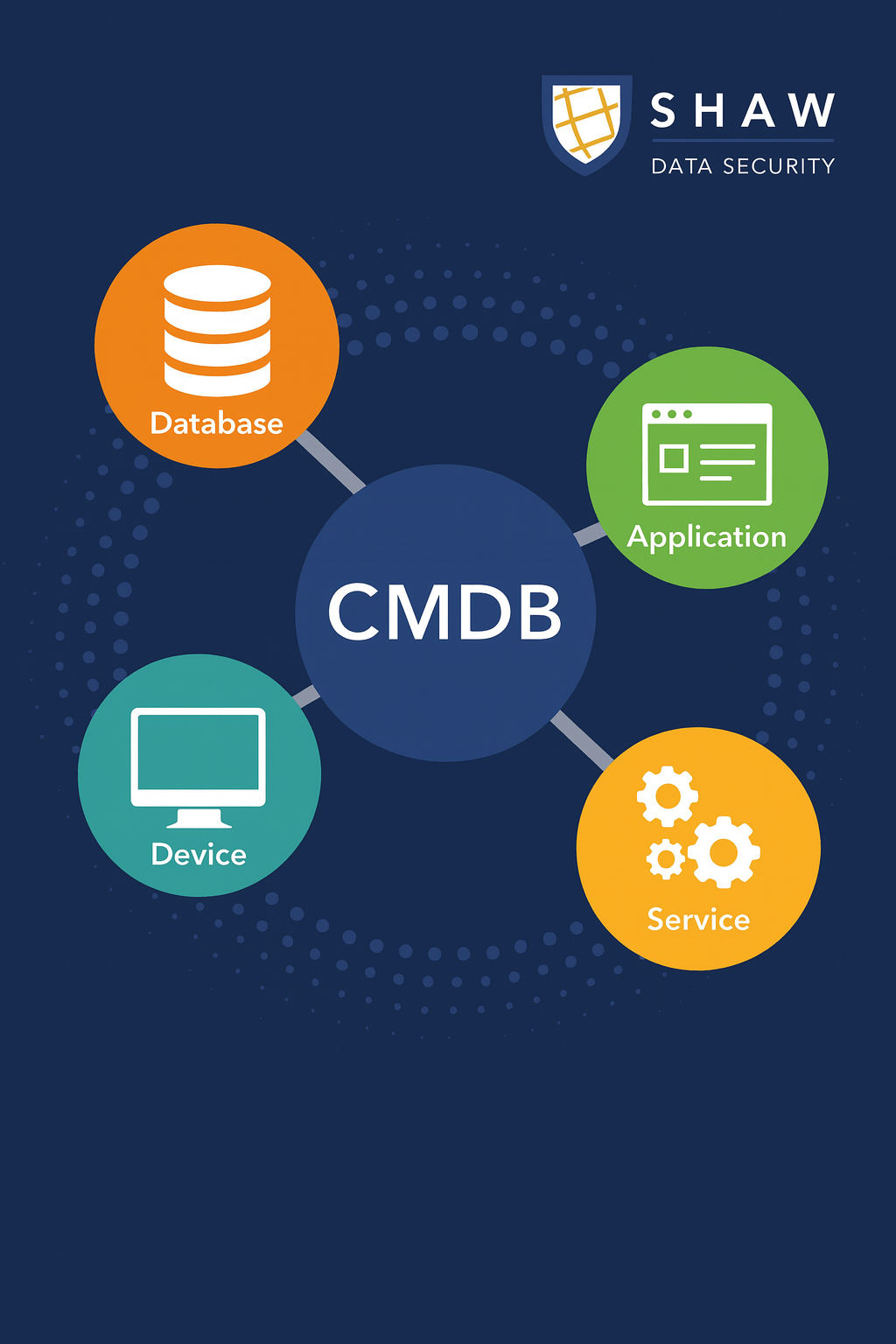
A CMDB is more than a database. It is the backbone that connects infrastructure, applications, assets, changes, incidents, knowledge, and workflows into a living operational picture. When your CMDB is healthy, every module becomes more effective. When it is incomplete or inaccurate, everything becomes reactive.
The CMDB dictates how data flows, how automation behaves, and how decisions are made. If the foundation is weak, the outcomes will suffer regardless of how strong the ITSM processes are.
Why Buying ITSM Without a CMDB Creates Operational Gaps
Organizations often underestimate how dependent ITSM is on contextual data. Incident routing depends on ownership. Change planning depends on dependency mapping. Major incident escalation depends on knowing what is critical and what is not. A CMDB without strategy leads to manual work, slow resolution, and inconsistent reporting. Without a CMDB strategy, your service desk becomes less automated. Changes become more risky. Visibility becomes fragmented. Everything becomes harder because the platform cannot see the environment it is meant to support.
What a CMDB Strategy Should Include
A CMDB strategy defines the rules, guardrails, and operational standards needed to keep data accurate and usable. It sets expectations for what to discover, what to store, who owns each class of data, and how each part of the organization interacts with the model. A well-defined CMDB strategy includes naming conventions, class models, data governance, population sources, integration standards, and lifecycle management. It defines how often data should be reconciled, which attributes matter, and how to prevent bloat. Without this strategy, CMDB accuracy degrades immediately after go-live.
Discovery, Integrations, and Data Governance
Discovery tools such as ServiceNow Discovery and Service Graph Connectors must be aligned with governance and platform architecture. Automated discovery accelerates data population, but governance ensures the data remains trustworthy. Integrations must be mapped, normalized, and reconciled according to the CMDB structure. Governance ensures that data remains consistent, avoiding duplicates, gaps, or inaccurate relationships. Together, these components create a predictable, reliable CMDB capable of supporting enterprise automation and analytics.
Why ITSM Outcomes Improve With a Mature CMDB
A strong CMDB improves operational performance in measurable ways. Incident response becomes faster because routing is accurate. Change success rates increase because impact analysis is real, not guessed. Major incident management becomes proactive instead of reactive. Service mapping connects technical dependencies to business impact, improving prioritization. Every part of ITSM becomes easier to operate and govern. Organizations consistently report fewer outages and shorter resolution times once their CMDB reaches maturity.
The Cost and Risk of Not Prioritizing the CMDB
Without a CMDB strategy, technical debt grows. Teams spend more time troubleshooting avoidable issues. Dependency decisions become unclear. Reporting becomes inconsistent. Projects take longer because data work must be done retroactively. This reactive approach increases cost, extends timelines, and reduces the long-term value of the ServiceNow platform. Investing in ITSM without a CMDB is like building a house without a foundation. You can get the walls up, but it will not withstand long-term use.
How SHAW Data Security Builds CMDB Success
SHAW’s CMDB methodology focuses on simplicity, accuracy, and maintainability. We begin with a clear class model, normalized naming conventions, and automated discovery aligned to real business needs. We design a governance model that ensures your CMDB remains healthy months and years after go-live. Our approach accelerates adoption, reduces rework, and strengthens every downstream process including ITSM, ITOM, IRM, and Asset Management. Most importantly, we deliver a CMDB that is usable on day one and scalable for long-term operational maturity.
Before organizations purchase ITSM or begin an implementation, they need a CMDB strategy. It ensures the platform is stable, reduces operational risk, increases reliability, and enables the automation ServiceNow is designed to deliver. A strong CMDB creates a strong ServiceNow environment, and the earlier the strategy is defined, the faster the platform produces real value.